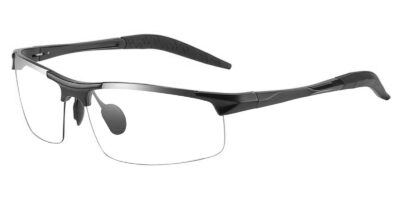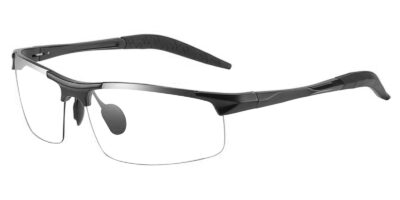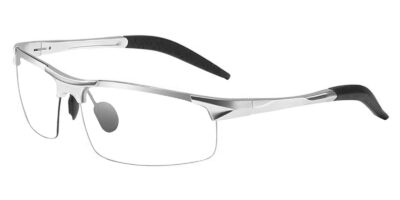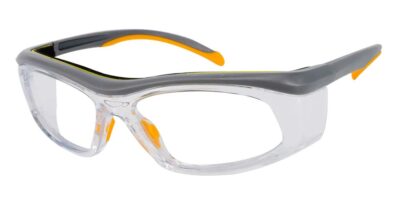
Explore Wrap Around Safety Glasses shaped to follow the natural curve of the face. Their swept-back profile brings the outer edges closer to the temples, creating a streamlined fit with fewer open areas at the sides than a flat-front frame.
Use this collection to compare frame curvature, lens dimensions, bridge design, temple shape, and supported ranges. Because curved frames position the lenses at an angle, not every Rx can be produced in every model.
Choose wrap around safety glasses that remain stable, provide a comfortable field of view, and suit the way you move while working. Review the measurements and Rx limits on each product page before placing your order.
Traditional flat-front frames sit mainly across the front of the face. A wrap profile curves backwards toward the temples, giving the frame a closer, more continuous shape from the centre to the sides.
This design may appeal to people who prefer less open space around the outer lens area or want a frame that feels stable during frequent movement. The curved shape can also create a clean, low-profile appearance without relying on large external side pieces.
However, the word “wrap” should describe a measurable frame characteristic—not simply a sporty appearance. Products included in this collection should show clear evidence of their curvature through side-view images, frame specifications, or manufacturer data.
Why Rx Compatibility Matters
Curved frames can be more complex to fit with corrective lenses than flatter designs. When the lenses turn inward around the face, their position in relation to the eyes changes.
Optical laboratories may need to consider the frame’s wrap angle, lens curve, vertex distance, and the way the frame sits on the wearer. HOYA describes wrap angle, tilt, vertex distance, and eye position as position-of-wear measurements that can influence the finished lens calculation. It also offers compensated lens designs specifically for wrap frames.
For that reason, a Rx that works in one curved model may not be available in another. Compatibility can be affected by:
Sphere and cylinder values
Axis measurements
Prism requirements
Lens material
Lens width and height
Frame curvature
Required lens thickness
Single-vision or multifocal design
The laboratory process available for the selected model
Each product page should provide a genuine supported range. Avoid using a single universal safety limit across the entire collection.
Understanding Wrap Angle and Base Curve
Two terms are especially useful when comparing Wrap Around Safety Glasses.
Wrap angle
The wrap angle describes how far the front of the frame curves backwards toward the sides of the face. A greater angle generally creates a more swept-back profile.
This measurement helps explain why two products with similar lens widths can sit very differently. One may remain relatively flat, while the other follows the temples more closely.
Base curve
The base curve relates to the curvature of the lens surface. A more strongly curved frame usually needs a lens configuration that works with its shape.
The frame and lens should be considered together. Installing an unsuitable lens curve may alter the frame shape, affect the fit, or make the finished product visually uncomfortable. HOYA notes that the base curve can be selected to suit the chosen frame and that specialised wrap designs may use optical compensation.
Where this information is available, show it clearly on the individual product page instead of leaving shoppers to judge curvature from the photographs alone.
What to Check on Each Product Page
A useful wraparound listing should provide enough information to evaluate both fit and Rx feasibility.
Look for:
Front and side photographs
Frame wrap angle where available
Lens base curve where available
Total frame width
Lens width and height
Bridge width
Temple length
Frame material
Eligible lens designs
Product-specific protective information
Limitations stated by the manufacturer or laboratory
The side image is particularly important. It reveals how quickly the frame turns toward the temples and whether the arms continue the curved profile.
A Secure Fit Starts at the Bridge
A curved front does not automatically create a secure fit. The bridge still needs to support the frame in a stable position.
When the bridge is too wide, the frame may slide and sit lower than intended. If it is too narrow or the shape does not suit the nose, it may create pressure and hold the lenses too close to the face.
The bridge position also affects how the curved lenses align with the eyes. A frame that sits too high, low, or unevenly may not provide the intended viewing experience.
Compare the bridge dimensions with a frame that already fits you well. Adjustable nose components can offer some flexibility, but they cannot fully correct a frame that is substantially the wrong size.
Check the Temples and Side Contact
The temples should follow the sides of the head without pressing sharply or spreading away from the face. In a well-proportioned wrap design, the curved front and the temple arms should work together to hold the frame steadily.
Pay attention to:
Pressure near the hinges
Contact at the sides of the head
The bend behind the ears
Temple length
Grip during downward movement
Compatibility with other head-worn equipment
A frame that is too narrow may press at the temples, while one that is too wide can lose the close side position that defines the category.
Peripheral Vision Should Remain Comfortable
A closer side profile should not make the wearer feel visually restricted. The lens shape, frame thickness, and fit can all influence what is seen toward the edges.
NIOSH recommends adjusting protective eyewear to provide proper coverage, comfort, and adequate peripheral vision.
When trying a new frame, check whether you can look forward, downward, and toward either side without the frame edge becoming unnecessarily distracting. Some wearers may need a brief adjustment period, particularly when moving from a flat frame to a more strongly curved design.
Persistent blur, discomfort, or visual distortion should not simply be ignored. Recheck the measurements, lens configuration, and frame position.
Side Coverage Is Not the Same as Sealed Protection
Wrap around safety glasses can reduce open space at the outer sides, but a curved profile does not create a complete seal around the eyes.
Do not use appearance alone to decide whether a product is suitable for dust, liquid splash, vapour, or another specialised exposure. Those applications may require a different construction and verified hazard-specific performance.
OSHA requires suitable side protection where flying objects are a hazard, while the exact product must still be selected according to the workplace exposure.
Keep this page focused on curved-frame geometry. Detailed standards terminology belongs on the separate standards-led collection, and enclosed designs belong on their dedicated page.
Consider Other Equipment Before Ordering
A swept-back frame may interact differently with equipment worn around the head.
Check whether the temples sit comfortably beneath or alongside:
Hearing protection
Helmets
Head straps
Masks
Respirators
Communication equipment
Pressure from another item can push the frame forward, change the lens angle, or create discomfort at the temples. The full setup should remain stable without forcing the frame away from its intended position.
Thin or flexible temples may feel better beneath some equipment, but the correct choice depends on the complete fit rather than temple thickness alone.
Selecting the Right Lens Shape
Large, deeply curved lenses can provide an open visual appearance, but they may also create greater Rx challenges. A more compact lens shape may be available for a wider range of prescriptions or may produce a thinner finished lens.
Consider how the lens dimensions work with your prescription:
Wider lenses may require more lens material.
Stronger prescriptions may become thicker toward the centre or edges.
High curvature can limit available lens designs.
Multifocal layouts need enough usable lens height.
The finished lens weight can change how the frame sits.
The largest frame is not necessarily the most practical choice. A slightly smaller model may offer a better balance of coverage, lens feasibility, weight, and visual comfort.
How to Order Wrap Around Safety Glasses
Begin with a current prescription and confirm that all values are complete. Then:
Choose a curved frame that suits your facial width.
Review its prescription range and eligible lens designs.
Compare the bridge, lens, and temple measurements.
Check the side photographs and available curvature data.
Enter the prescription exactly as written.
Provide the requested pupillary-distance information.
Select only lens options supported by the model.
Review the finished configuration and total cost.
Contact customer support before ordering when the prescription is strong, complex, or close to the stated limit. It is better to confirm feasibility early than to select a product that must later be changed.
FREQUENTLY ASKED QUESTIONS
What are Wrap Around Safety Glasses?
Wrap Around Safety Glasses use a curved frame profile that follows the sides of the face while incorporating corrective lenses. The degree of curvature, supported prescription range, and available lens configuration vary between models.
How are wrap around safety glasses different from flat frames?
A flat frame sits mainly across the front of the face. A wrap design curves backwards toward the temples, creating a closer side profile. The difference should be visible in side photographs or supported by frame-curvature information.
Can every prescription be fitted into a wrap design?
No. Compatibility depends on prescription strength, cylinder and axis values, lens shape, frame curvature, lens material, and the laboratory process. Review the supported range for the individual model rather than assuming every product accepts the same values.
Why does the wrap angle matter?
The wrap angle affects how the lenses are positioned in front of the eyes. Greater curvature may require additional measurements or an optically compensated lens design to maintain comfortable vision.
What is the base curve?
The base curve describes the curvature of the lens surface. It should be suitable for the chosen frame so the finished lenses fit correctly without unnecessarily changing the frame shape.
Can strong prescriptions be used in wrap around safety glasses?
Some strong prescriptions may be available, but options are often more limited in deeply curved or oversized designs. A smaller lens shape, different frame curvature, or specialised lens process may be required.
Are progressive lenses available in wrap designs?
Availability depends on the frame’s lens height, curvature, prescription, and supported manufacturing options. Check the product page before ordering because not every curved model can accept every multifocal design.
How should a wrap frame fit?
It should sit level, remain stable during movement, and follow the sides of the head without excessive temple pressure. The bridge should support the frame without repeated sliding, and the lower edge should not press against the cheeks.
Do wrap around safety glasses provide complete side protection?
They can provide a closer side profile, but curvature alone does not confirm a particular protection level. Check the product-specific markings, construction, and intended use.
Are wrap designs sealed around the eyes?
No. A typical curved frame still has openings around parts of the eye area. It should not be treated as sealed protection for splash, fine dust, vapour, or similar exposures unless the specific product documentation states otherwise.
Can a wrap frame affect peripheral vision?
The lens shape, frame edge, prescription, and fit can influence peripheral viewing. A properly selected design should provide comfortable coverage without creating unnecessary visual obstruction.
Why might vision feel different in a curved frame?
The lenses are positioned at a different angle than they are in a flatter frame. Wrap angle, tilt, vertex distance, lens design, and fitting measurements can all affect the finished viewing experience.
Can wrap designs be worn with hearing protection?
They may be compatible, but the temple shape and thickness should be checked. Hearing protection can press against the arms, create discomfort, or shift the frame out of position.
What measurements should I compare before ordering?
Compare total width, lens width, lens height, bridge width, and temple length. Also review the wrap angle, base curve, prescription range, and frame weight where those details are available.
When should wrap around safety glasses be replaced?
Replace the product when the frame becomes cracked, distorted, loose, or unable to hold its intended shape. Replacement may also be necessary when the lenses become damaged, visual clarity declines, or the prescription changes.
WE PROMISE YOU ALL THIS
Free US & Canada Shipping
Free 30-day returns, no questions asked!
Secure payments
Contact Us :Chat Online|Phone: 1-855-598-2020
|Email: service@caglasses.com